• The subject of gossip vs. talebearing and “sharing of information” has recently been coming up frequently among my circle. So I decided to take a deep dive and research all of the above with how God views such things kept close in mind. The subject of gossiping in church the main focus but I encourage you as you read this to apply it to your everyday life. I think it will be surprising how the conversations in your life will shift if you remove these certain elements from your speech and evaluate what is actually necessary information to share about others and what is not. I believe you will find it’s a lot quieter when you don’t talk about other people and their business. So quiet you just might hear what God has to say to you instead. So let’s get into it.

    The word gossip is not in the bible, but in its place is Talebearing or Talebearer which essentially is very similar. The bible also references tattlers, busy bodies and backbitting.

     In first Timothy 5:13 KJV the bible says this.

       And withal they learn to be idle wandering about from house to house and not only idle but tattlers also and busy bodies speaking things which they aught not.

    A talebearer is a person who spreads gossip or rumors

    A tattler or tattletale is someone who tells secrets about what someone else has done (an informer)

    A busybody is an officious or inquisitive person.

    Officious means volunteering ones services where they are neither asked nor needed also referenced as a meddler.

    Inquisitive given to examination or investigation, inclined to ask questions.

    Backbitting is malicious talk of someone who is not present.

    Rumor is defined as talk or opinion widely disseminated with no discernible source.

    The bible speaks against meddling in other peoples affairs as seen in first Peter 4:15 KJV

       But let none of you suffer as a murderer, or as a thief or as an evil doer, or as a busybody in other men’s matters.

    How frequently do you insert yourself into others affairs? How often do you ask questions to receive unnecessary information just for your own satisfaction or arsenal of details about another to judge criticize or otherwise chew on and slobber over, to be in the know? Now is a good time to search your heart roll back over conversations regardless of intent at the time and evaluate whether they were truly of value or if they match any of these definitions.

    More verses describing talebearing and speaking against it can be found in the following verses.

    Leviticus 19:16

    Proverbs 11:13 A talebearer revealeth secrets but he that is faithful concealeth the matter.

    Proverbs 17:09 He that covereth a transgression seeketh love, but he that repeateth the matter seperateth friends.

    Proverbs 18:08 the words of a talebearer are as wounds , and they go down into the innermost parts of the belly.

    Proverbs 20:19

    Proverbs 26:20 Where no wood is, there the fire goeth out so where there is no talebearer the strife ceaseth,

    Proverbs 26:22 (Repeats proverbs 18:08)

    Psalms 50:19-20  thou givest thy mouth to evil, and thy tongue frameth deceit. Thou sittest and speaketh against thy brother thou slanderest thine own mothers son.

    Now that we have our verses and our definitions nailed down lets talk about it. It is easy to accidentally fall into the trap of talebearing, busybody and rumor filled conversations because they are often concealed as venting or valuable information to request prayer or pre service small talk. Church is for fellowship to glorify God and praise him. Talking about aunt Susans arrest last Thursday or cousin Johnny’s 4th wife, or who was at a party last night but not at service this morning does not count as fellowship even if you add lets pray for them at the end.

    Conversations that start with “I heard” or “I think” and end with “I guess” or “so I’ve been told” or even “But I’m not sure.” Usually contain something from the definition list we just went over. If you’re not sure don’t say it, and don’t repeat it. Just because you heard it even from someone you trust doesn’t make it true and if your guessing why are you sharing. Its also good to remember to not say anything about anyone you wouldn’t say to their face, now my problem is there isn’t much I wouldn’t say to someone’s face so I have to add a few more guidelines for myself which is 1.) how would I feel if it was me in their place. 2) does this glorify God in any way and 3) is it necessary to say?

    The Term talebearing derives form the combination of tale and bearing meaning to carry or bring forth a story or report. Bearing derived from old English beran meaning to carry.

    So I ask you what are you carrying? Are you carrying praise? Good report ? Or are you carrying stories, rumors, hearsay etc. Are you asking questions out of care and love and necessity or are you asking to gain information to tell others. Our speech is to mirror Gods truthful word. Love for thy neighbor cannot coexist with whisper campaigns, spreading of private information, negative talk, chewing on peoples decisions like it’s a fresh turkey leg on thanksgiving day. Where gossip, talebearing, backbiting, rumors and idle chatter thrive love, trust, faith, mercy and peace decay.
  • GETTING SOBER

    You left me in October, said you were getting sober.

    Turns out you were getting over me.

    Oh can’t you see the

    Flies that hover over your lies.

    Tell me how many lives you have.

    Is it truly over? Are you finally sober from me?

    Oh can’t you see

     How I beg you down on my knees.

    Please.

    I miss blue skies and butterflies

    Your bedroom eyes.

    Now all we have is wildfire lies and lonely nights.  

  •        For the first time in my life I don’t know who I am.

          I am 29 years old and I have quit my job to be a SAHW and student. I went to the Dr. the other day and he asked so “what do you do” he had no idea what weight that question carried. For the first time I didn’t have an answer, I didn’t have a title to boast or confidence in an occupation. I stammered though the reply with I uh uh am , I uh stay at home. He cocked his head sideways glanced down at my ring finger and smiled.” Oh you have kids?” Uhg another question that was hard to answer. No kids… yet. I threw the yet in there because it made me feel less like a failure. Kids are not even a goal but somehow just being a SAHW isn’t enough. Society requires more but why?

          Why do I feel like being a wife isn’t enough that taking care of a home with no children is less valuable than being a 9-5 professional?

           I started working at 17. I eventually got my GED when I was 21 or 22. I worked hard as a waitress and a bank teller, Hostess, Receptionist and lastly a CNA. For 12 years my identity was closely knit to whatever profession I had at the time. Now I don’t know who I am. I’m 29 years old and I look in the mirror and I don’t know my own reflection. I’m a good 100 pounds overweight, I have no college degree, no income and absolutely no clue what to do with the rest of my life. Anxiety and depression not to mention a general sense of listlessness I no longer know how to go about my days.

     What am I now? Who am I now? What value do I have now?

           I was expressing this to my husband stating that I felt a little lost and didn’t know what to do next. He replied I want you to be happy just being my wife and not worry about what’s next. I mulled this over for half the night tossing and turning in bed. Just his wife. Just a wife. Not worrying about what’s next ? That in itself is a foreign concept my whole life has been moving on to the next thing. But now suddenly I have a huge opportunity to take a step back and evaluate who I am and where I am going. What if I majored in the wrong thing? What if it’s not what I am “meant” to do?

           This got me to thinking what does God say about life and purpose? I grew up in a religious household so terms like “purpose” and “calling” “Spiritual gifts” were all frequently used in my upbringing. But how did all of that apply to me? How was I supposed to know what to choose what was purpose and what was happenstance. God doesn’t exactly come down on a cloud or a burning bush anymore. This is what I found in my search for understanding of purpose and what to do with the life he gave me.

    Ecclesiastes 12:13 Let us hear the conclusion of the whole matter; fear God, and keep his commandments; for this is the whole duty of man.

    Micah 6:8 He hath shewed thee . O man, what is good and what doth the Lord require of thee, but to do justly , and to love mercy, and to walk humbly with they God?

    1 Corinthians 10:31 Whether therefore ye eat, or drink, or whatsoever ye do,do all to the glory of God.

    1 John 2:6 He that saith he abideth in him ought himself also so to walk, even as he walked.

    Mark 16:15 And he said unto them, Go ye into all the world, and preach the gospel to every creature.

     (Just a few verses on this topic, I encourage you to research for more !)

          It’s not about what you do but rather how you do it. It doesn’t matter if you become a doctor or a fry cook the point is do you glorify God in what you do and how you move about your life. While it is a great feat to be Christ like and loving people somehow the world doesn’t seem so overwhelming. Coming to the conclusion that you can’t choose the wrong profession whether that is staying home or a high achieving executive. God don’t care about your degrees or titles he cares about how you care about him and others. So guess what it doesn’t matter which school you go to what job you leave or accept but rather the spirit you do it with.

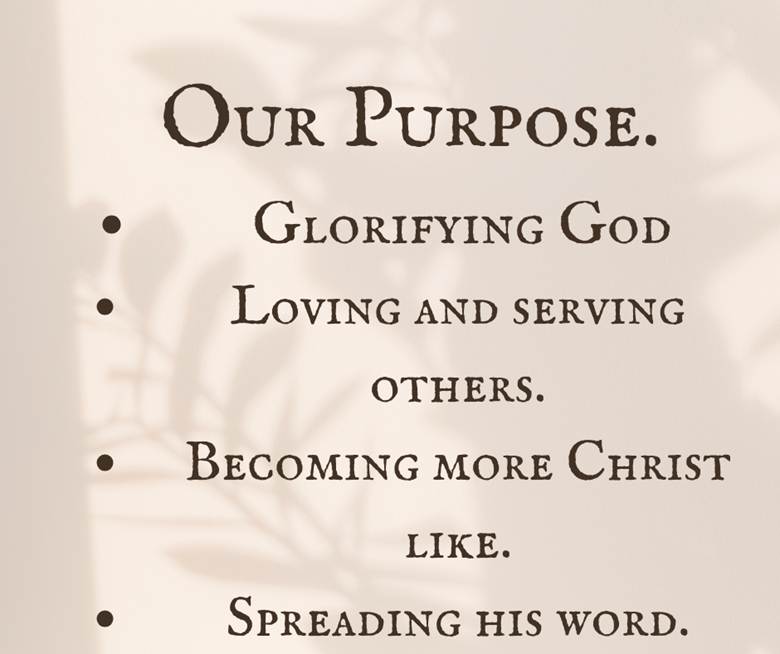
    If all you do today is get out of bed praise God for waking up , glorify him love and serve others, work to become more like him and sharing his word with others well congratulations you have fulfilled your purpose for the day.

    Now I don’t claim to have this all figured out by any means. I still struggle with anxiety I still have to stop myself from fretting over what ifs and what next. But when I can remind myself that God sees me, God knows my efforts it helps me to take a deep breath and put things back into perspective. Life isn’t nearly as complicated as we like to make it.

    Somehow I find comfort in the fact that it doesn’t matter who I am, it matters who HE is and he is an awesome God, a forgiving, loving, dependable God. He loves me and he loves you too.

  • In the wake of the murders committed just this past week, I am left in shock at the hate and support of murder. As I go to bed tonight, with my husband next to me, the two of us tucked away safely in the deep South, I have come to the stark conclusion that we are not so safe anymore.

    Never has my livelihood, my freedom of speech, my freedom to worship God seemed so threatened. It’s not political, it’s spiritual, and it’s time we see it as it is. It’s not about the guns, the legislation, the political party; it’s about humanity, it’s about the threat to the family unit. We are in the last days. We have been told of times such as these. Times where good is taken as evil, where the love of God is viewed as the hate of others.

    In the age of social media, it is easy to focus on the bad. Our news feed is littered with war, murder, and hate. As we move forward from this week of tragedy, I hope we choose to move forward in the search for love, understanding, and peace. The answer is not to be angry, to repay death with death, but rather to take this opportunity to show the greatness of love, the love of God, and the love of his people. We can disagree on politics, we can disagree on religious practices, we can find fault in each other easily, but for once, let’s not. For once, let’s respond in love, in prayer, in thanksgiving for what is good.

    I want to remind my fellow Christians that we are to pray for our enemies. So as we hold candle light vigils and stand united, lets also pray for those with whom we do not agree. Pray for the lost, the widow, the murderer, and both families involved. The answer is prayer, the solution is love and vengeance is the Lord’s. God knows the hearts of others; we do not. Our purpose is to love God and love others.

    Let us go forward and walk in love as God has loved us. Amen. Amen.


  • Whenever I would call my mom to complain about the woes of life in my early 20s (everything seemed so big then), after expressing the stress and worry over whatever situation I was going through, she would always say—much to my annoyance—“This too shall pass.”

    At the time, this was the last thing I wanted to hear. I didn’t recognize the comfort in the phrase. I often thought, Yes, I know it will pass and be over at some point, but I’m living it now. Right now, it hurts.

    She was right, of course—as mothers usually are. It always did pass. There was always an end to whatever trouble I had.
    (Yes, Mom, I put it in writing: you were, and are, usually right.)

    The “this too shall pass” sentiment has been around a long time. I thought Mom made it up for a while, but evidence proves otherwise. They’ve even written country songs about it—Gary Allan sang Every Storm Runs Out of Rain, a 90s classic and the anthem of many backroad drives with no destination in mind back when gas wasn’t $5 a gallon. You can even find it in scripture:

    Psalms 30:5

    > “For his anger endureth but a moment; in his favour is life: weeping may endure for a night, but joy cometh in the morning.”


    And my favorite:

    Ecclesiastes 3:1

    > “To every thing there is a season, and a time to every purpose under the heaven.”


    Whatever it is—it will pass. It may not be easy, and it may hurt, but it will pass.

    It wasn’t until I was 28 that I really allowed myself to accept the fact that everything passes—the good, the bad, the painful, the sad, the happy—it all passes. That’s how I came to the name of this blog site and my Etsy shop: Rainey Days Pass Art (I’ll link it below). On a rainy day a few months ago, in the midst of the worst depressive episode I have ever experienced, I was reminded: This too shall pass. The rain will clear. The sun will shine again.

    So, if you are going through a hard time, remember—it’s temporary. Nothing on this earth lasts forever. This too shall pass. You just have to hold on and wait out the storm.

    If you’re in a happy time in your life, appreciate it. Hold on to it. Our experiences are precious, and our time is fleeting. This too shall pass.

    Thank you for reading my Rainey Days Blog.

    Call to Action:
    💬 What reminder gets you through the tough days? Share it in the comments so we can lift each other up. And if you need a little visual reminder that “this too shall pass,” you can find my Rainey Days Pass designs in my Etsy shop—made to bring comfort and hope on even the stormiest days.

    http://www.raineydayspassart.etsy.com

    Email me at Raineydayspass@gmail.com


  • This morning, as I sat on the couch drinking my Earl Grey tea and listening to my husband snore in the other room, I reflected on a recent conversation I had with a friend. We were talking about our work as CNAs at the hospital and how it differs from that of CNAs in nursing homes.

    There’s less lifting, fewer bathroom trips, and baths are generally less intensive, as most patients are able to bathe themselves. Typically, there’s a quick turnover—patients don’t stay long—except for our “frequent flyers,” many of whom we come to love in our own way, or at least feel some sympathetic connection toward.

    But one thing seems constant: you are only as valuable as what you produce—how fast and efficiently you complete your rounds, the number of baths given, charts completed, supplies scanned, and the cleanliness of your patients’ or residents’ rooms. That stuck with me. You’re only as valuable as what, and how much, you can produce. It’s no different than an air conditioning unit: how well you cool the room and how efficiently you run.

    So, what are you producing outside your job responsibilities? We all put something into the atmosphere—our attitudes, our appearances, our conversations. What would the workplace look like if we valued these just as much? What if, alongside attendance rewards, we recognized the best-maintained attitude or the most empathetic care for patients or residents? What if we changed the scoreboard?

    Every workplace requires a certain level of competence in measurable skills: multitasking, efficiency, teamwork, or the ability to work independently. I’m not suggesting we remove value from those skills, but rather that we add something else to the criteria. Unfortunately, we’re still far from employers truly recognizing and rewarding qualities like empathy, patience, and integrity. Leadership often has a limited—or distorted—view of the people who work for them.

    We’ve all seen it: the coworker who gets the most praise because every time the boss turns the corner, they put on a show of stellar performance. But as soon as the boss leaves, they drag them through the mud—or worse, boast about being the one who “really runs the place.”

    That’s why it falls on us—as leaders, coworkers, friends, and human beings—to pay attention to what we put out into the world. You can’t have a toxic attitude and expect it not to affect the room when you walk in. Sometimes, the environment depends on you.

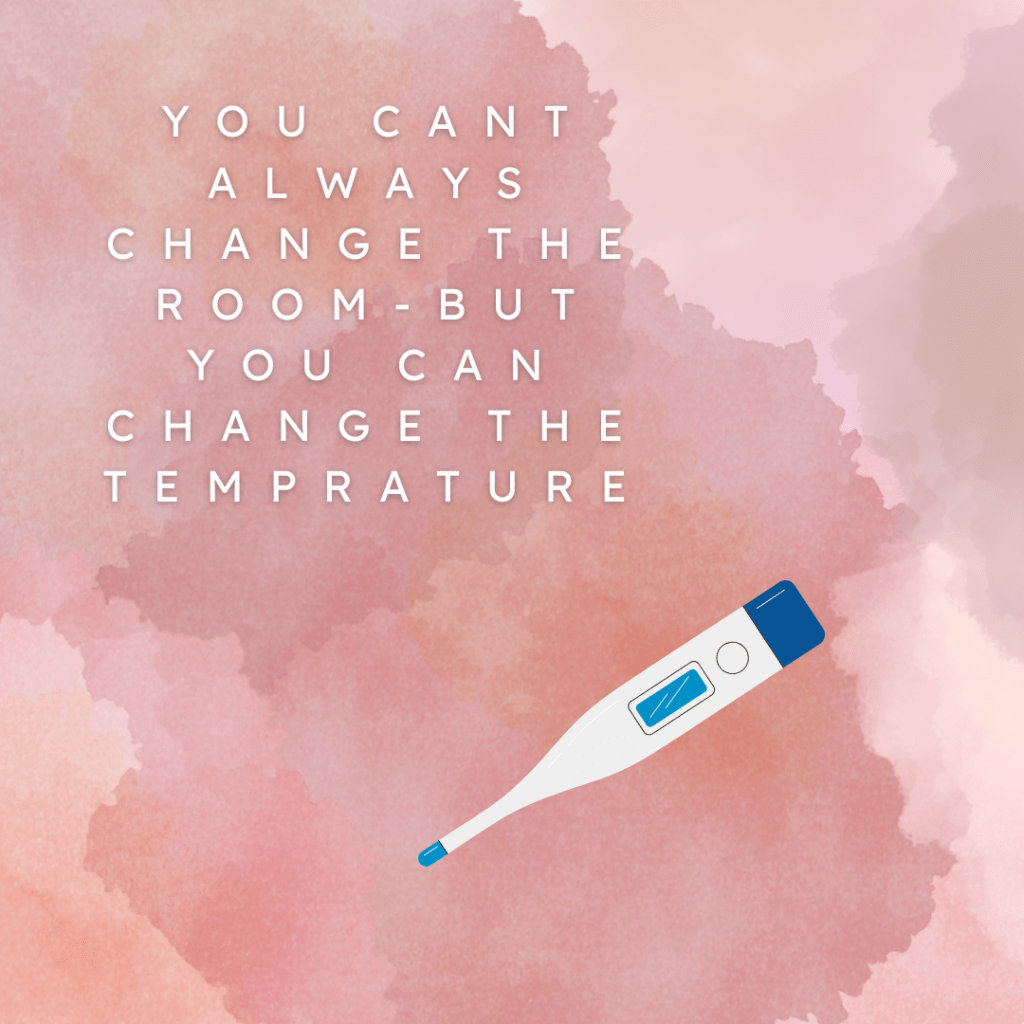
    You can’t always change the rooms you have to walk into—but you can change the temperature.

    > Your turn: How do you change the temperature in the rooms you walk into? Drop a comment and share this with someone who needs the reminder.


  • Taking Back the Wheel: Letting Go of What Others Think

    Hello friends,

    Let me ask you something: How much power do the thoughts of others have over you?

    This is a question I’ve been asking myself lately. During a recent session with my therapist, I was venting about the anxiety I’ve felt surrounding my grandparents’ high expectations—particularly what they might think if I change academic directions. I also shared my frustration that my husband doesn’t seem to understand the pressure of making good grades in my pre-nursing program. His “C’s get degrees” attitude might work in business or other majors, but in nursing? Not so much.

    As I rambled on, caught up in the whirlwind of being misunderstood and pressured, my therapist stopped me and asked:

    “Does how people perceive your situation affect your success?”

    “Can you control how they think about grades or achievements?”

    I paused. Then I answered: “No, I can’t.”

    That moment hit me hard—and it changed something in me. I realized I had been giving all my power away to the thoughts and opinions of others. Their judgments—real or imagined—were ruining my day. I wasn’t even in control of my own thoughts because I was so wrapped up in theirs.

    But how do you break that cycle? How do you stop caring so much about what other people think? How do you get your power back?

    1. Battle Phrases (a.k.a. Affirmations)

    I like to call them battle phrases—short, empowering truths I repeat when I notice I’m slipping into people-pleasing or anxiety about how others see me.

    • I can’t control what other people think.
    • Everything someone thinks about me isn’t necessarily true.
    • They have a right to think whatever they want about me.
    • Not everyone is going to like me.
    • Other people’s opinions don’t define who I am.

    It’s human nature to want to be liked and to make others happy—but if pleasing others becomes your internal compass for how you live, speak, dress, or act, you will eventually feel lost. Worse, you may drift far from your true self. You might even miss out on your full potential because you were too busy trying to live someone else’s version of your life.

    2. Ask Yourself the Hard Questions

    When you’re about to make a decision or hesitate on a dream, ask:

    • Am I doing this because I genuinely want to—or because I’m worried what others will think?
    • Am I avoiding something out of fear of judgment?
    • Is this decision coming from fear?

    What are you holding back on right now just because you’re afraid of what people might say? If you removed the fear of other people’s thoughts, what would your life look like?

    Would you start that business? Dye your hair purple? Take yourself out to that restaurant you’ve been dying to try?

    Why are we handing over our power to something we can’t control—something as fickle as the opinions of others?

    It’s time to step back into the driver’s seat. Clear the roadblocks of fear and judgment, and chart your own path. Choose your playlist, blast it loud, take detours, rest stops, and scenic routes when you need them. This is your life, your journey.

    You are in control—not the thoughts or expectations of others.

    And remember: it’s not a competition. We’re all just trying to make it through this world the best way we know how.


    Let’s Keep the Conversation Going
    Have you ever caught yourself living for someone else’s approval? What helped you take your power back? I’d love to hear your thoughts in the comments below.

    If this post resonated with you, feel free to share it with a friend who might need the reminder that they’re in the driver’s seat, too.

    ✨ For more reflections on mental health, self-growth, and everyday resilience, check out more posts at http://www.raineydayspass.blog and subscribe so you don’t miss a thing!


  • Stop. Drop. Roll.

    Not just for the fire drills 🔥🚒👨‍🚒


    You know those kinds of days when you’re carrying the laundry from one room to the next, and you drop a sock—then drop three more items when you bend down to pick up the first one?

    Or maybe you open a cabinet and your Jenga-stacked Tupperware comes toppling down.

    Or the TV remote gets stuck on the number 2, and you find yourself endlessly scrolling to the mythical channel 222222.

    And let’s not forget the honorable mention: Netflix buffering right at the most intense part of a show.

    All of these are minor, everyday inconveniences—on a good day. But on a bad day? Look out. Suddenly, it’s the cherry on top of your already not-so-happy sundae.

    But why?
    Why do some days feel like every little thing is out to get us?

    So, I went looking for answers. I was hoping to find something like “It’s not you” or at the very least, something that didn’t suggest I needed an attitude adjustment.

    Unfortunately, after some extensive Googling, I found exactly what I didn’t want to see:
    It is me.
    And yes, I do, in fact, need an attitude adjustment.
    And if you relate to any of this—you probably do too.

    But don’t worry, I made us a helpful little list on how to gently reframe our thinking.
    (“Reframe your thinking” is therapist-code for “Change your attitude.”)


    STOP, DROP, and ROLL!

    STOP:
    No, there’s no fire. Just us and our flaming tempers. But the “Stop, Drop, and Roll” method still applies.
    Stop in your tracks before you decide to throw out every piece of mismatched Tupperware that just rained down on you.

    DROP:
    Drop the nasty attitude that’s got you ready to chuck that Tupperware like it lost its own lid. Why are we taking our frustrations out on inanimate objects that we arranged (poorly) in the first place?

    ROLL:
    Roll with it. Take a deep breath. If the worst part of your day is tumbling plastic, a sticky remote, or clean laundry hitting a dirty floor—maybe the day isn’t actually that bad.


    I’ve come to realize:
    If the thing ruining my day won’t matter in five years… why spend five minutes being that upset about it?

    Honestly, I feel like this generation—and the one just entering the workforce (and drinking legally—God help us all)—gets more worked up over nothing than past generations did over anything.

    Sometimes, when I’m spiraling and life feels heavy, I remind myself:
    I’m not 28 years old with six kids under 10, no washing machine, and no dishwasher.
    I don’t have to go out to the garden at dawn to gather food so we can eat later.

    When I think about what my ancestors endured and survived, my bad day starts to feel… not so bad.


    So, I guess the point is:
    Most “bad” days aren’t really that bad.
    It’s our perspective that needs a little adjusting.

    How do you cope with days such as this?

    Do you think the previous generation had it worse ?

    What modern convienance are you grateful for?

    Tell me !!

    Raineydayspass@gmail.com


  • How to Talk to Yourself
    By Amanda E. Lemmond

    We learn how to speak at an early age, and as we grow older, we learn how to speak to different people in different tones of voice. Our mothers could quiet us with just one look. But here’s something we’re almost never taught: how to talk to ourselves.

    And yet, we are the person we talk to the most.

    Today, I want to talk about how speaking to yourself with the same respect you’d show your grandmother, and the same gentleness you’d offer a child, can transform your mental health and self-worth.


    1. When You Make a Mistake

    What’s the first thing you say to yourself when you mess up?
    Is it something like:
    “You’re so dumb.”
    “You should have known better.”
    “Everyone is going to think you’re an idiot.”

    If that sounds familiar, you’re not alone — but let’s be clear: that’s verbal abuse, even if it’s coming from yourself.

    If a stranger walked up and said those things to you, would you tolerate it? Would you like them? Of course not.

    So why is it okay when it comes from you?

    Here’s a mindset shift:
    Yes, you made a mistake — but you also learned something.
    You are human, not a machine.
    You can’t control what others think, and their opinions don’t define your worth.

    Treat yourself with compassion. You’re doing the best you can.


    2. When You Look in the Mirror

    Let’s be honest: most of us do this. We look in the mirror and zoom in on what we don’t like.

    “I’m so fat.”
    “I’m so unattractive.”
    “My eyes are uneven.”
    “I look awful.”

    Would you say those things to a child? I hope not. If you wouldn’t say it to someone else — especially a vulnerable version of yourself — don’t say it in your own mind either.

    Try this: imagine your younger self looking back at you in that reflection.
    Would you speak differently?

    You deserve to speak kindly to the person in the mirror.


    3. When Someone Doesn’t Like You

    It’s normal to want to be liked. Truly, it is.
    But it’s not logical to expect everyone to like you.

    And that’s okay.
    You don’t need universal approval.

    The only person you really need to get along with — is you.

    Let that sink in: You are stuck with yourself for life. You might as well make peace with the person you are and start treating yourself like someone you love.


    4. You Are Not Your Thoughts

    Thoughts are like internet search results — not all of them can be trusted.

    The next time you hear that cruel voice in your head, pause and say to yourself:
    “I am not my thoughts. Not everything I think is true.”

    Your mind can lie. But your heart knows better. Choose to believe in your worth, even when your thoughts try to convince you otherwise.


    A Challenge for the Week

    I want to challenge you:
    This week, when negative self-talk creeps in, don’t follow the usual script.

    Instead of beating yourself up, try something new:

    • Talk to yourself the way you’d talk to someone you love.
    • Catch the cruel thoughts, and replace them with grace.
    • Treat yourself like you matter — because you do.

    You are more than a reflection in the mirror.
    You are more than your worst moments.
    You are valuable, worthy, and deserving of kindness — especially from yourself.

    I would love to hear from you. Please interact with this post or feel free to email me !

    📩 raineydayspass@gmail.com


  • Making Space in the Workplace for Mental Health

    By Amanda Rainey

    Hello friends,

    My name is Amanda Rainey, and today I want to talk about something close to my heart—making space for mental health in the workplace. No matter what field you’re in, mental health matters. Every workplace is different, and no two people experience mental health the same way. But here’s the thing: according to the World Health Organization, 1 in 5 people struggle with a mental illness. That means if you work with even just four coworkers, chances are at least one of them is silently struggling.

    Since the COVID-19 pandemic, reported mental health issues in the workforce have risen by 25%. That’s not just a statistic—it’s a signal that we need to pay attention to what’s happening in our offices, hospitals, restaurants, and everywhere in between.

    As someone diagnosed with anxiety and depression, I know firsthand how these conditions can make work more difficult. Things like attendance, personal hygiene, and maintaining work relationships can become major challenges. And when the work environment is toxic, tense, or lacks understanding, it only adds to the weight we’re already carrying.

    But I believe change is possible—and necessary. And it doesn’t all fall on the employer. As employees, business owners, and coworkers, we can all help create a healthier, more compassionate workplace. Here are some ways we can start:


    1. Enforce Breaks

    Breaks aren’t just a perk—they’re essential. Especially in high-stress jobs like healthcare, having time to breathe and decompress is critical. A short pause in the day can reset the mind and improve performance. When people are given space to rest, they’re more likely to respond calmly and clearly in stressful situations.


    2. Use Your Breaks Wisely

    Don’t skip your break—and don’t waste it. I know, deadlines are tight and tasks pile up. But pushing through without rest only drains you faster. Remember, you can’t pour from an empty cup. Instead of using your break to gossip or complain (which only adds negativity), take a moment to breathe, stretch, journal, or text someone who brings you joy. Even five minutes of positive focus can shift your whole day.


    3. Open Communication

    Employers: be clear and compassionate about your expectations. Create an environment where your team feels safe to disclose mental health concerns if they choose to. Consider allowing mental health days—time off that doesn’t count as vacation or sick leave but is designated for emotional well-being. Even offering just five mental health days per year with a 48-hour notice could change your team’s morale for the better.


    4. Speak Up About Your Needs

    If you’re struggling with anxiety, depression, or any other mental health issue, consider letting your employer know. You don’t have to go into detail—just being honest about your situation can lead to more understanding and support. Honesty creates connection, and it may give your employer the chance to support you better.


    5. Build a Positive Environment

    Workplaces thrive when kindness is the norm. If there’s someone on the team who constantly brings negativity or causes conflict, that energy affects everyone. Managers: encourage counseling and set clear expectations for respectful behavior. It only takes one toxic attitude to unravel the efforts of an entire team.


    6. Don’t Be That Person

    We’ve all worked with a “Negative Nancy”—the person who complains constantly, gossips, or brings down the mood. Don’t be that person. Lift others up, speak kindly, and focus on solutions instead of problems. The energy you bring into the room matters more than you know.


    A Personal Story

    When I was younger, I worked my second job as a waitress at a small local restaurant. The job itself wasn’t glamorous, and the pay was just above minimum wage. But what made it special—what made it the best job I’ve ever had—was my manager.

    He cared. Genuinely. He asked how we were doing and actually listened. He offered advice when we needed it. One day, I was venting to him about a rude customer. I’ll never forget what he said:

    “We’re all just trying to get through this world the best we can.”

    That moment stuck with me. It reminded me that everyone is carrying something, even if we can’t see it. Not everyone copes in ways we understand or agree with—but most people are doing the best they can. With 1 in 5 people silently battling a mental health challenge, you know someone who’s struggling. Be kind to them. And be kind to yourself. Let’s make room for mental health at work.


    💌 Note from the Author

    Thank you for reading this blog post. I’d love to hear from you!

    • How do you cope with mental health in the workplace?
    • Do you think employers should offer mental health days?

    Let me know by emailing me at:
    📩 raineydayspass@gmail.com